
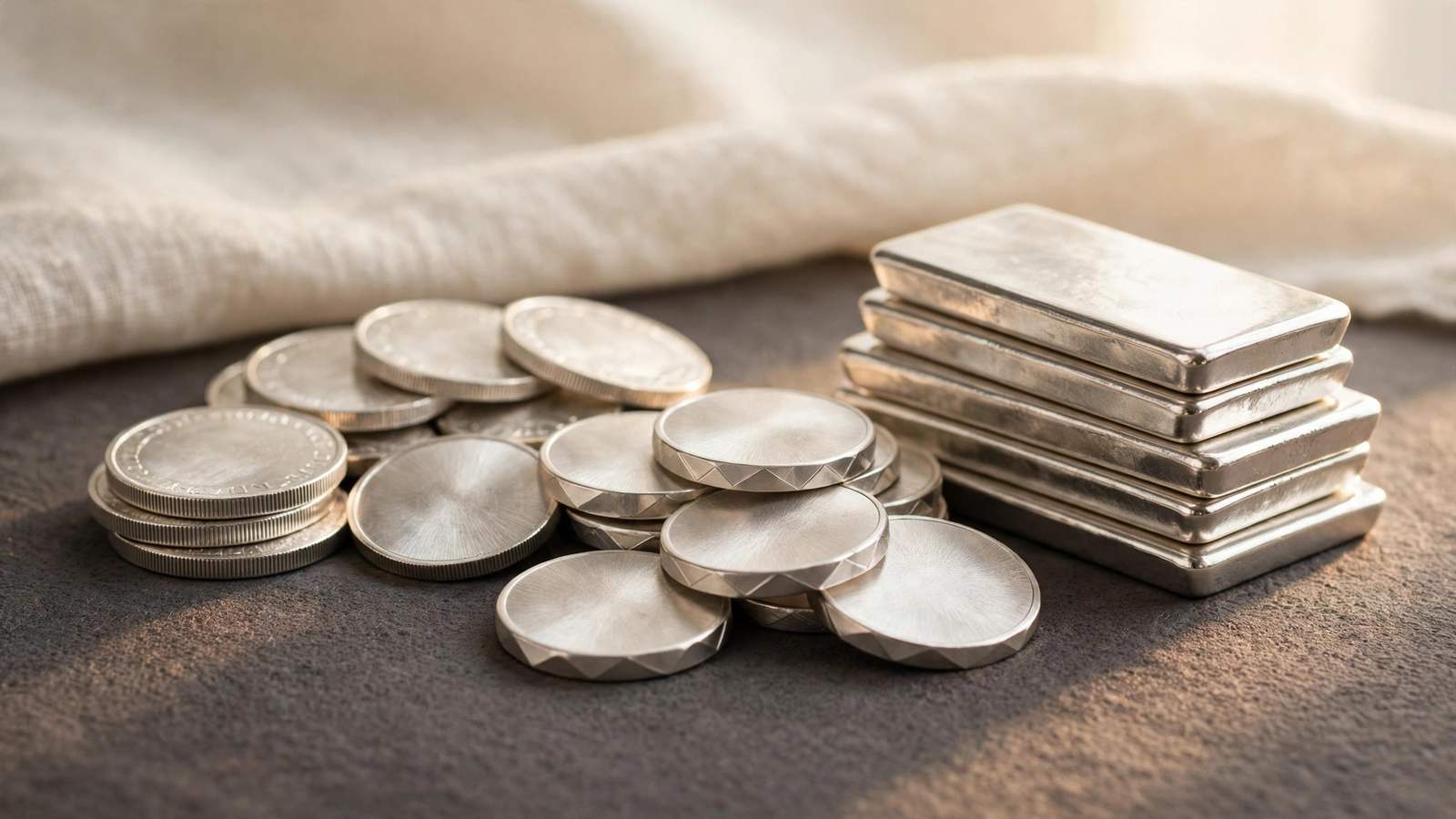
Coins, bars and rounds are all real silver, and a troy ounce in any one of them holds the same amount of metal. What changes is what you pay on top of the metal value, what sizes you can buy, and how easy a piece is to sell later in a small amount. For a buyer who adds a little each month, those three differences matter more than the shape itself.
The short answer is this. Bars usually carry the lowest price per ounce, especially in larger sizes. Government issued coins usually carry the highest price per ounce, and in return they are the most widely recognized pieces in the world. Private mint rounds sit between the two on price, and they share the handy one ounce size of coins without being coins in law. Many regular buyers end up with a mix, and the worked example below shows why the mix is not indecision. It is a trade off between cost now and flexibility later.
How the three forms differ
- Coins. A coin is issued by a government mint and carries a face value, even though that face value sits far below the value of the metal. That official origin is why dealers and private buyers recognize the major coins at a glance, and why a single coin is simple to sell on its own. The cost of that recognition is the highest premium of the three forms, and special designs or collectible finishes can push the price higher still without adding any silver.
- Rounds. A round looks like a coin but is made by a private mint and carries no face value. It is a piece of silver and nothing more, and its price sits closer to the metal value than a government coin does. Well known mint marks help a round sell, while an obscure design can take longer to place with a dealer. In plain terms, rounds trade a little recognition for a lower price per ounce.
- Bars. A bar is silver cast or pressed into a block, in sizes that run from one ounce up to very large blocks, with common stacker sizes at five ounces and ten ounces. Larger bars usually carry the lowest premium per ounce of any form, because one sale moves more metal with less handling. The catch is flexibility. You cannot peel two ounces off a ten ounce bar, so a large bar is sold whole or not at all, and a sealed assay pack or a trusted mint mark matters more as the bar grows.
Size is the quiet fourth difference. Coins and rounds in the one ounce size fit a monthly routine, because each month can add one more piece. A larger bar asks you to save across several months before you buy, and while you save, the price can move up or down. That wait is part of the true cost of the lower premium, and the example below keeps it in view.
Worked example
Three buyers each follow the same routine for one year. Each one sets aside $120.00 a month, so each one spends 12 × $120.00 = $1,440.00 in total. One buyer spends the total on government coins, one on private rounds, and one on larger bars. To keep the maths easy to check, spot is held at $30.00 per troy ounce for the whole year, and the all in prices are round figures for teaching, not live quotes. Real premiums move with demand, dealer stock, and order size.
- The coin buyer pays $40.00 per troy ounce. The premium is $40.00 − $30.00 = $10.00 per troy ounce. The total buys $1,440.00 ÷ $40.00 = 36 troy ounces. Check the split: the metal itself is 36 × $30.00 = $1,080.00, the premiums add 36 × $10.00 = $360.00, and $1,080.00 + $360.00 = $1,440.00.
- The round buyer pays $36.00 per troy ounce. The premium is $36.00 − $30.00 = $6.00 per troy ounce. The total buys $1,440.00 ÷ $36.00 = 40 troy ounces. Check the split: the metal itself is 40 × $30.00 = $1,200.00, the premiums add 40 × $6.00 = $240.00, and $1,200.00 + $240.00 = $1,440.00.
- The bar buyer pays $32.00 per troy ounce. The premium is $32.00 − $30.00 = $2.00 per troy ounce. The total buys $1,440.00 ÷ $32.00 = 45 troy ounces. Check the split: the metal itself is 45 × $30.00 = $1,350.00, the premiums add 45 × $2.00 = $90.00, and $1,350.00 + $90.00 = $1,440.00.
- Compare the three stacks. The bar buyer ends with 45 − 36 = 9 more troy ounces than the coin buyer and 45 − 40 = 5 more troy ounces than the round buyer, for the same $1,440.00. The round buyer ends with 40 − 36 = 4 more troy ounces than the coin buyer. On cost alone, the bar wins by a clear margin.
Now add the buying rhythm back in. The coin buyer and the round buyer can buy in one ounce pieces as the year goes along, so their routines run month by month with no saving up and no waiting. The bar buyer reaches the low per ounce price only in larger bars, so the routine becomes a cycle of saving, waiting, and then buying a larger piece at whatever price is live on that day. If the price rises while the bar buyer saves, some of the premium saving is given back in a higher spot price. If the price falls, the wait pays twice. Neither outcome can be known in advance, which is why the honest comparison is not cost alone. It is cost, weighed against how soon you want the silver in hand and how you may want to sell it later.
Run your own numbers
Open the free Silver DCA Calculator on the homepage and enter the three paths as three short sessions. Add one buy of 36 troy ounces at $40.00 per troy ounce and the calculator shows a $40.00 average on $1,440.00 spent. Clear it and add 40 troy ounces at $36.00, then clear it again and add 45 troy ounces at $32.00. The averages match the worked example, and the ounce counts show what the premium gap costs or saves. For your own routine, enter the real all in price you paid for each coin, round, or bar, with shipping included in that order total, and the calculator will blend mixed forms into one average for the whole stack. Your portfolio stays in your own browser; nothing is uploaded.
Mistakes to avoid
- 1. Comparing spot in place of the all in price. Spot is the same for every form, so spot alone can never tell you which form costs less. Compare the full price at the checkout for each form, shipping included, and divide by the ounces in the order.
- 2. Paying a collectible premium and expecting it back. A special design, a limited run, or a proof finish can raise the price of a coin well above a plain bullion coin. A dealer buying for metal value may pay for the silver and the recognition of the series, with little or nothing for the design that cost you extra. Buy a design because you value it, and count the extra as the price of that pleasure, not as silver.
- 3. Putting the whole stack into one large bar. A single large bar gives you one piece to sell and no small pieces. If you later need to sell a small amount, the choice is the whole bar or nothing. Buyers who may sell in parts usually hold at least some of the stack in one ounce pieces.
- 4. Assuming a round is a coin. A round carries no face value and no backing from a government mint, and that is fine as long as you know what you hold. Trouble starts when a buyer pays a coin price for a round, or expects a round to carry the same recognition as a major government coin at resale.
Variations to try
- Hold a low cost core and a flexible edge. Buy larger bars when you can for the low premium, and hold a share of the stack in one ounce coins or rounds that can be sold one piece at a time. The blend keeps the average down while it keeps your options open at sale time.
- Let the routine choose the size. In months when the budget is small, add a one ounce round or coin. In months when a bonus or a few saved months add up to a larger sum, buy the larger bar and take the lower premium. The routine stays the same, and the form follows the amount in hand.
- Check the sell side before you buy. Ask your usual dealer what they pay for each form and how fast each form moves for them, in general terms. A form that is cheap to buy and simple to sell in your own town can beat a form that wins on a price chart alone. Local demand is part of liquidity, even though no chart shows it.
Want your own average worked out? The free Silver DCA Calculator on the homepage blends your purchases into one average cost per ounce and tracks your profit and loss at the live spot price, your portfolio stays in your own browser, nothing is uploaded.
Open the calculator